What Is Nose Taping After Rhinoplasty?
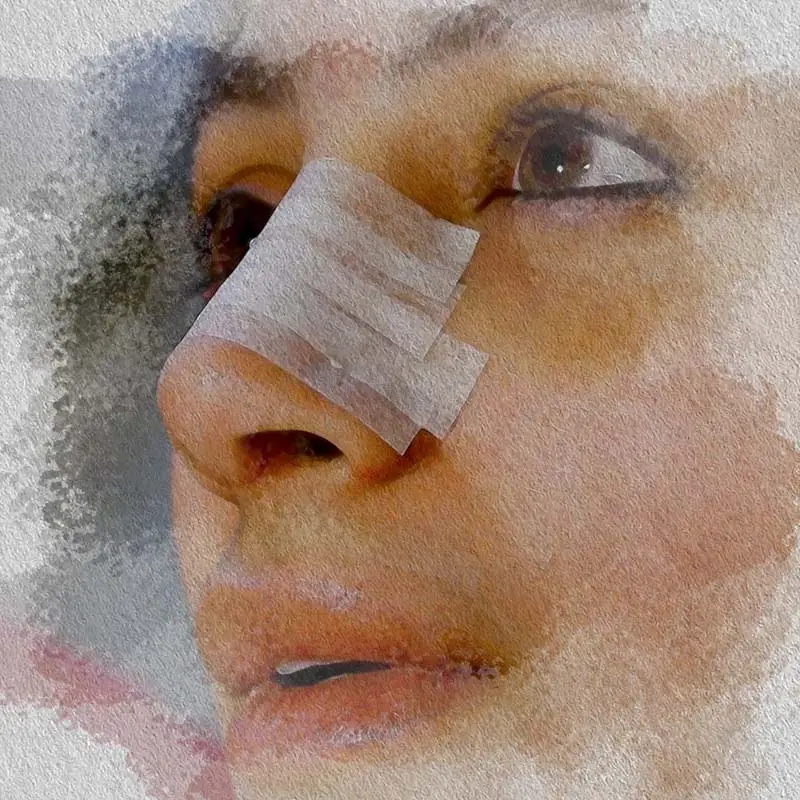
Nose taping after rhinoplasty refers to the application of small strips of medical adhesive tape, typically paper tape or hypoallergenic surgical tape over the nasal dorsum and occasionally around the tip. The taping applies gentle, downward support and compression to help manage swelling and maintain contour during the early phases of healing. Taping should NOT be done directly over the nasal tip but rather around it.
Taping does not change the bone structure or the cartilage framework; instead, it influences soft-tissue behavior as swelling fluctuates.
What Is the Purpose of Taping? (Why It’s Used)
-
-
- Helps reduce soft-tissue swelling
Light compression can limit overnight edema, especially in patients who experience persistent dorsal or tip swelling.
- Helps reduce soft-tissue swelling
-
- Gently compresses and approximates and the soft tissue
In the first few weeks, the skin and soft-tissue envelope are adapting to the underlying structure. Taping helps maintain a smooth drape, especially in thicker-skinned patients.
- Gently compresses and approximates and the soft tissue
-
- Provides subtle contour guidance
Taping can prevent puffy areas from obscuring early definition, helping the dorsum and supratip contour appear more refined sooner.
- Provides subtle contour guidance
-
- Offers a sense of protection
Many patients feel more secure with tape at night—it acts as a reminder not to bump, press, or sleep face-down on the nose.
- Offers a sense of protection
When Should You Tape the Nose?
This is the most important part and the most commonly misunderstood.
In general:
Unless instructed by your surgeon I would not tape in the first 2–3 weeks.
The nasal bones and cartilage framework might have been manipulated during surgery and could still be unstable. Applying or removing tape can unintentionally shift tissues or apply shear forces you do not want.
Instead consider starting around week 3–4, and definitely communicate with your surgeon prior to starting, At around 3 weeks the bony frame work has become stable and robust, and taping becomes safe and potentially useful for controlling post operative swelling.
Duration:
Most patients who benefit from taping use it:
- At night,
- For 2–3 months,
- Or until their swelling pattern becomes stable.
Who Benefits Most From Nose Taping?
Patients with:
- Thicker skin
- Persistent supratip/dorsal swelling
- Mild nighttime swelling or puffiness
- High-definition rhinoplasty where early refinement is desired
- Revision rhinoplasty with known soft-tissue edema tendencies
Who Should NOT Tape?
Patients should avoid taping without surgeon approval if they have:
- Significant tip work early in the recovery (risk of instability)
- Osteotomies (bone cuts) less than 3 weeks old
- Fragile nasal skin or skin irritation with taping
- Pain or pressure with light touch
- If taping causes discomfort, pressure marks, or increased swelling
.
Does Nose Taping Change the Shape of the Nose?
No.
It does not permanently change bone or cartilage structure.
What it does influence is:
Soft-tissue swelling
Smoothness of the skin envelope
Temporary contour refinement during early healing
Think of it as a swelling-management tool, not a sculpting tool.
How to Tape the Nose (General Explanation – Not Medical Instruction)
General concepts:
- Use paper tape.
- You start at the bridge or at the tip. The lymphatic outflow is to the side so both works but I will start at the top of the dorsum , descending toward the tip.
- Always apply the tape first in the middle of the nose, with gentle, not forceful, pressure.
- Avoid wrapping the tape aggressively around the tip.
- Always remove tape slowly, with warm water or moisturizer if needed.

What is my Approach
In my practice, I don’t routinely tell my patients to tape because I don’t feel the need to. Using a preservation rhinoplasty technique I don’t see the typical issues with nasal swelling than with older techniques. Occasionally I make an exception and recommend taping in the post operative period. Usually I reserve taping for patients with:
- Thick-skinned patients
- Patients that underwent a very minor changes during their rhinoplasty so that they can appreciate the changes sooner
- Patients who feel that there nose is very puff in the morning and want nighttime contour support
Final Thoughts
Nose taping can be beneficial in reducing swelling and improving the early postoperative contour after rhinoplasty, but it is not essential for everyone. When used appropriately and at the right time, it can make the healing process feel smoother and more comfortable.
Important Disclaimer:
Always follor your Surgeon’s Instructions
Every rhinoplasty is different. The amount of bone work, tip work, grafting, septal support, and soft-tissue thickness all determine whether taping is safe or helpful.
Do not begin taping without the approval of your surgeon.
What is appropriate for one patient may be harmful for another, especially in the first 3 weeks when the nasal pyramid can be unstable.